AI-Agent Ecosystems – The Foundation for Autonomous Data Platforms

Table of contents
- Abstract
- Agility, governance, and scalability
- Agentic AI: Tailored LLMs
- Networked Intelligence: How the Agentic Ecosystem Orchestrates Data Democratization
- Efficiency, scalability, compliance
- Using Agentic AI to create an autonomous data platform
- Self-healing infrastructures and autonomous marketplaces
- From data to AI governance
- Agentic AI: Powering the Data Platform of the Future
- References
Abstract
The transformation from monolithic data platforms to decentralized architectures like Data Mesh promises high agility. However, this agility often falls short in practice due to the massive staffing scale required within business domains. Rapid backlog growth often results when requests to and within domains cannot be handled smoothly.
Agentic AI catalyzes cross-functional teams in Data Mesh structures by filling critical niche roles and strengthening individual domains. AI agents operate as proactive, autonomous entities, standing in sharp contrast to reactive LLM systems. They independently orchestrate complex problem-solving through their own logic, domain-specific memory, and the targeted deployment of external tools.
Agents directly respond to user requests within their domains, analyzing them and autonomously connecting with agents from other domains as needed. This interaction culminates in a multi-agentic ecosystem. This network automatically resolves internal, external, and hybrid data requests across domain boundaries, while a “compliance-by-design” architecture guarantees strict adherence to centralized data governance. Ultimately, this implementation drastically accelerates time-to-value via automated data operations while simultaneously achieving high ecological resource efficiency through specialized models.
Agility, governance, and scalability
Modernizing data platforms is an ongoing imperative for data-driven companies. This evolution frequently requires dismantling monolithic systems in favor of decentralized structures. Greenfield projects achieve scalability by embedding decentralization from day one, whereas brownfield migrations typically progress in phases. Consequently, legacy systems operate alongside the new architecture until they are finally decommissioned. Ultimately, a decentralized approach forms the fundamental baseline for a scalable, future-proof data platform, regardless of the starting point.
Removing Complexety via Domain Driven Design
The Data Mesh concept provides the ideal framework for this decentralized approach. This federal data architecture fundamentally breaks with purely centralized structures, organizing data logically into domains instead. As a result, companies are dismantling legacy systems and eliminating their typical monolithic bottlenecks. Complexity drops massively through this paradigm shift, which replaces centralized integration in physical storage with decentralized, domain-oriented data models
(Dehghani, 2022; Hackler, Leifheit, & Weber, 2022).
This structural shift also fundamentally transforms the architectural approach to data redundancy. Modern cloud architectures deliberately leverage intentional physical redundancies—a sharp contrast to classic monoliths, which strictly avoided redundant data to enforce consistency. Deliberately distributing data (e.g., through domain-specific databases) not only ensures resilience but also drives team decoupling and high performance (Kleppmann, 2017).
However, decentralization demands an overarching framework to prevent this necessary distribution from devolving into isolated data silos or conflicting duplicates. A hybrid approach solves exactly this: centrally managed Data Governance enforces company-wide standards and security policies (Dehghani, 2022). Ultimately, this central framework eliminates logical contradictions from physical redundancy by establishing clearly defined domains as single sources of truth.
The new Teammember, the AI Agent
Instead, ownership moves into sharp focus within this setup. Data sovereignty shifts directly back to the business domains as cross-functional teams encapsulate the business logic. Consequently, domains transform from mere consumers into active producers that independently provide their information as “data as a product.”
However, staffing frequently becomes the critical bottleneck during implementation because a Data Mesh demands profound organizational change. Analytics components rapidly degenerate into hard-to-maintain systems, driven primarily by vacant team roles within individual domains. This organizational risk is especially acute for smaller companies, where the mandatory need for specialized expert teams quickly leads to structural vacancies.
Furthermore, splitting personnel across multiple domains undermines the fundamental principle of encapsulating complexity. Companies cannot solve this challenge through team-structure compromises. Instead, overcoming this hurdle demands targeted organizational preparation and successful resource building (Dehghani, 2022; Hackler, Leifheit, & Weber, 2022).
A future-proof architecture strictly requires the automated scaling of knowledge to combat this severe talent shortage. This automation allows companies to manage the cognitive load of business domains independently of scarce human capacity.
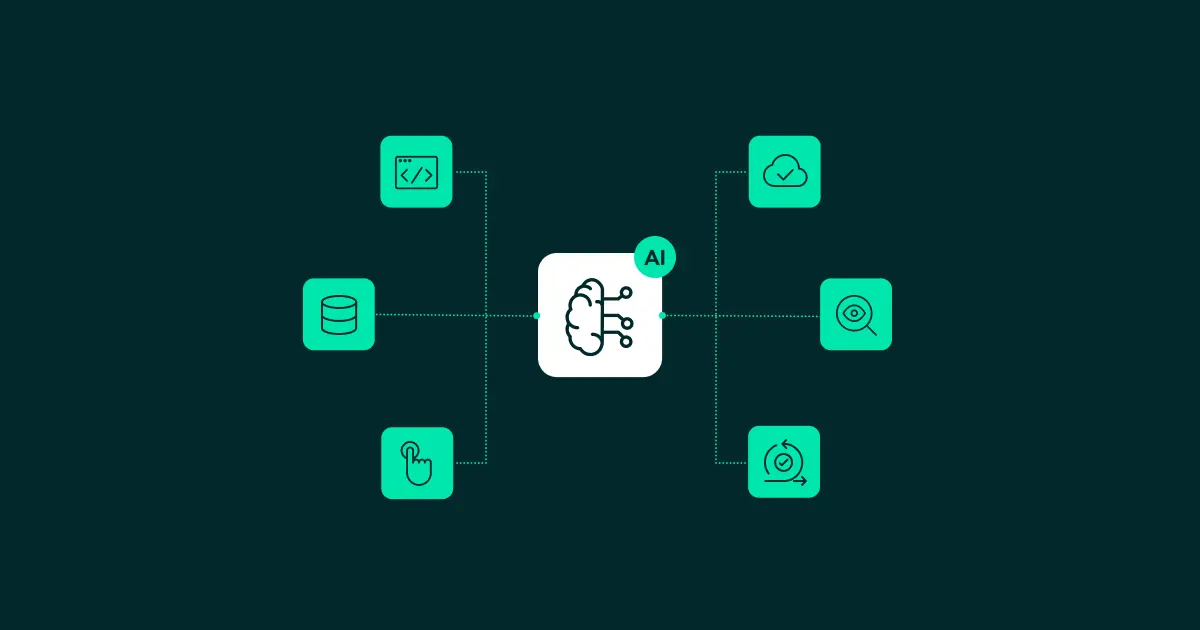
Agentic AI systems organically step in as a technological solution to meet this need. These intelligent systems actively manage technical requirements in line with data governance. Ultimately, this creates the essential foundation for scalable development while noticeably reducing the operational burden (Figure 1).
Agentic AI: Tailored LLMs
AI agents digitally extend domain teams as a proactive evolution of traditional Large Language Models (LLMs). AI agents independently make decisions and execute processes using their provided toolsets—a stark contrast to traditional chatbots that merely provide reactive knowledge. Agentic AI typically relies on core components, orchestrating their exact interaction flexibly depending on the chosen framework:
- Execution: AI agents operate autonomously using their allocated tools, guided by their ongoing observation, planning, and accumulated knowledge .technical interventions to explicit approval by the respective domain owners
(Weng, 2026). - Planning and Logic: The agent breaks down complex goals into manageable steps before dynamically drawing logical conclusions about the current state to decide on the next course of action. These steps occur either sequentially or iteratively (Haystack, 2026; Weng, 2026).
- Observation: The agent evaluates feedback from its environment or tool execution during this essential intermediate step to adapt its plan as needed (Mistral, 2026; ReAct | Yao, et al., 2023).
- Memory: A differentiated storage architecture—functionally divided into short-term and long-term memory—temporarily retains current chat contents and permanently preserves domain-specific expertise. Specifically, targeted storage within long-term memory secures strategic knowledge regarding internal (meta)data, regulatory data governance requirements, and precise domain definitions (Haystack, 2026; Weng, 2026).
- Tools: AI agents expand their operational radius by interacting with assigned interfaces, including databases, APIs, version control, code execution, and documentation (Haystack, 2026; Mistral, 2026; Wang, et al., 2023; Weng, 2026).
Regulated Autonomy via modular Frameworks
An agent’s primary goal is to actively solve the underlying problem by breaking down complex tasks and utilizing external tools, rather than merely answering questions (ReAct | Yao, et al., 2023; Wang, et al., 2023). This operational capability is rooted in a principle of controlled autonomy. Limiting each agent primarily to its own domain knowledge ensures horizontal scalability, closely mirroring the design of a decentralized data architecture (Dehghani, 2019; ChatEval | Chan, et al., 2023). Natural-language access provides users with a seamless interaction experience; however, executing technical interventions always requires explicit approval from the respective domain owners to comply with central data governance guidelines (Mistral, 2026).
Networked Intelligence: How the Agentic Ecosystem Orchestrates Data Democratization
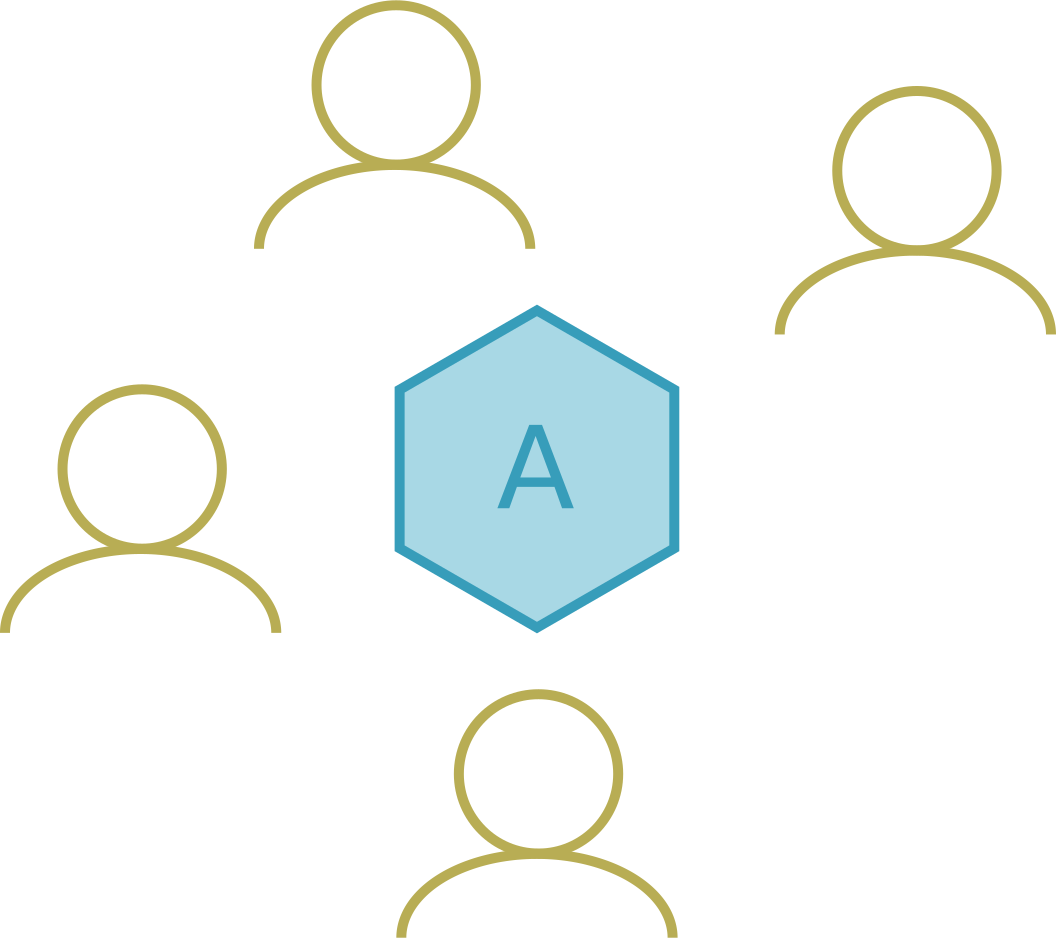
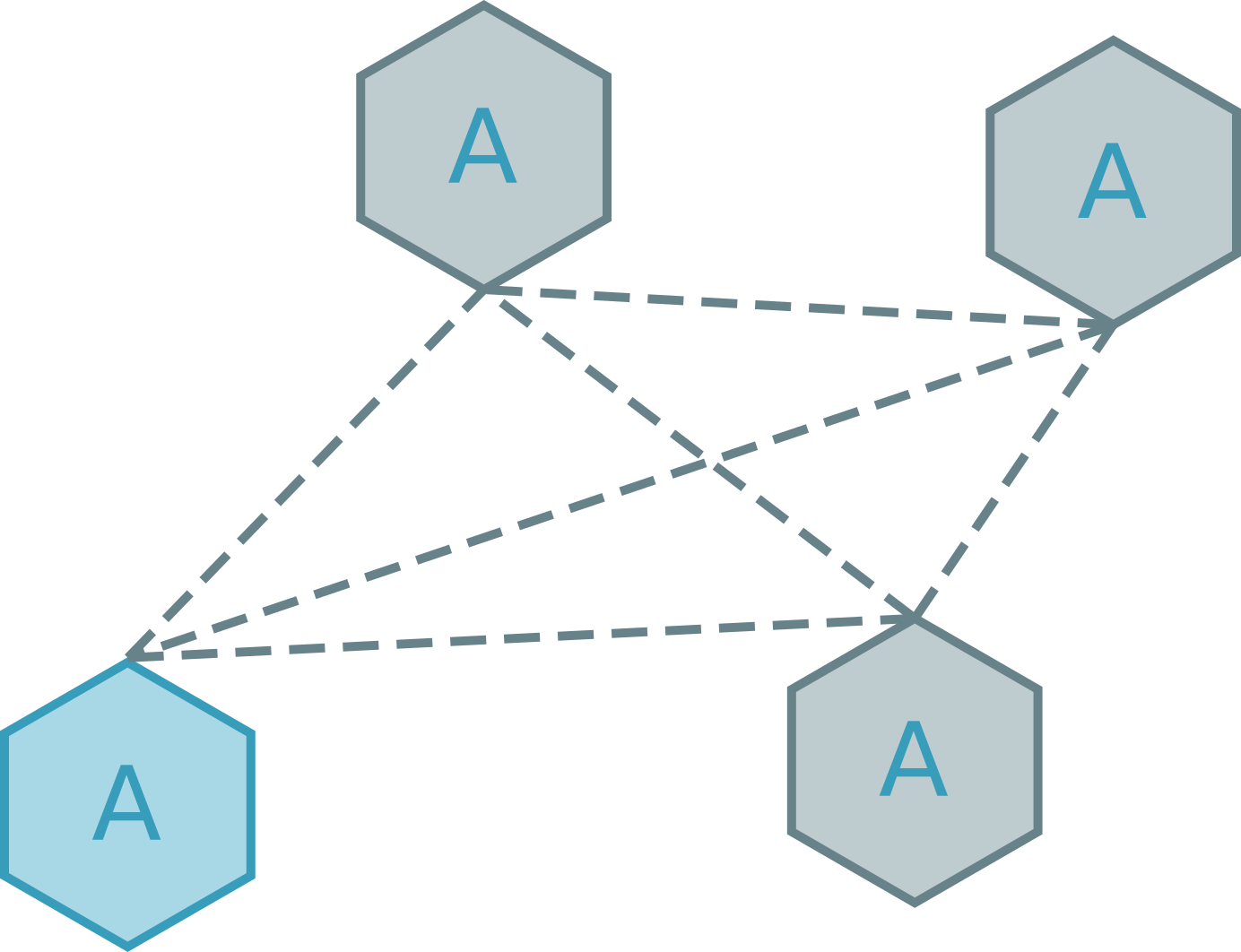
Knowledge management across decentralized data products and domains is intelligently automated to deliver the primary organizational value of AI agents. Tangibility for end-users is achieved through a dual-level system embedding architecture: operationally, AI agents are integrated within team structures as intuitive chatbots, while technically, they are anchored as AI agents primarily generate business value by intelligently automating knowledge management across decentralized data products and domains. Making this architecture tangible for users requires crucial system embedding on two levels: users interact with AI agents integrated as intuitive chatbots within team structures, while the underlying technical architecture anchors them as proprietary entities within their respective domains. Meanwhile, a dedicated resource platform handles inter-agent communication in the background, eliminating the need for users to interact directly with external systems (Figure 2).
Users can leverage natural language within this seamless dialogue to query whether specific information already exists locally or can be identified in neighboring domains. Autonomous communication drives this process as AI agents from different business areas exchange information to provide holistic answers to complex requests. Ultimately, this AI agent ecosystem actively powers optimal data democratization.
AI-Agent Regulatories
The system yields highly multifaceted results depending on the specific objective. For instance, when integrating new data sources, the agent automatically generates DML proposals and ETL code to import tables from neighboring domains, or identifies logical join criteria for existing data products. It can also immediately provide initial metadata analyses, basic reports, and evaluations to deepen the decision-making basis.
Strict compliance with governance guidelines remains a cornerstone of this architecture. Agents operate exclusively within their own domains, hold no write permissions for external systems, and maintain a strictly unidirectional data flow bound by hierarchical rules. In less invasive deployments, the system directly accelerates IT implementation: the agent formulates precise technical requirements for the domain team, guaranteeing faster and smoother execution for users.
AI-Agent Co-Piloting
AI agents derive their operational capability from a principle of controlled autonomy within clearly defined domain boundaries. Each agent operates primarily using its own domain knowledge while strictly complying with centralized data governance and overarching system mandates. This deliberate limitation directly prevents uncontrolled complexity and safeguards the horizontal scalability of the entire system.
Seamless access ensures a highly intuitive interaction experience for all users. The agent quickly delivers required data to business users without deep technical expertise, while simultaneously supporting technical experts with precise analyses of content and integration possibilities.
AI-Agent to Agent Interactions
Defining the depth of intervention serves as a critical factor here: agents operate within a framework that safeguards system integrity by automating read and analysis processes, while always requiring explicit approval from the respective domain owners and engineers for any final technical implementation. Combining the Data Mesh approach with centralized data governance provides a major strategic advantage. These overarching guidelines form the regulatory backbone that powers the automated creation of new data structures. Consequently, the agent ecosystem efficiently processes cross-domain requests while ensuring that technical execution seamlessly complies with governance standards and is fully logged.
AI-Agent Request Routing
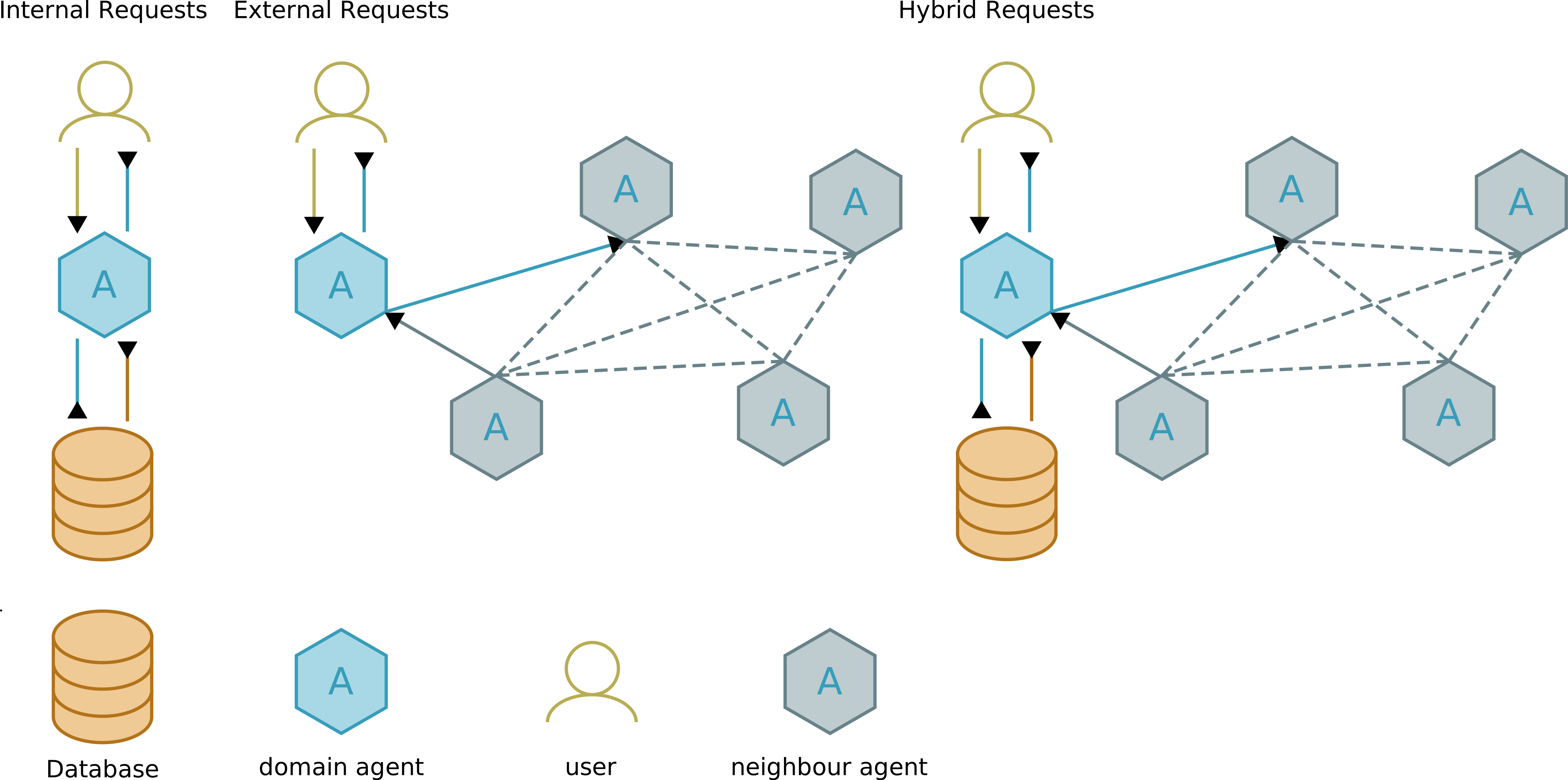
Requests are categorized as internal, external, or hybrid (Figure 3):
- Internal Requests: These encompass all scenarios where the agent can generate a response entirely from its own local data assets. Here, the agent acts as a local data structure expert to deliver fast, precise results without consulting external systems.
- External Requests: The AI agent enters a moderated dialogue with neighboring ecosystem agents whenever a request exceeds local domain resources. These neighboring agents clarify whether the requested information exists within their domains and outline the technical prerequisites for integration. Crucially, user and initiating agent security clearances strictly dictate the depth and quality of the final response.
- Hybrid Requests: Hybrid requests occur when a user query requires correlating local data with external domain data. The local agent orchestrates this process by merging internal insights with neighboring agent feedback, proposing optimal join criteria, and generating a holistic response that bridges both worlds.
This categorization completely shields users from data sourcing complexity while continuously safeguarding the sovereignty and security of individual domains in the background.
Efficiency, scalability, compliance
Implementing Agentic AI within a decentralized data architecture unlocks measurable efficiency gains for modern data platforms.
- Time-to-Value Efficiency: Automating data discovery and technical preparation (DML generation, join proposals, method definitions, template creation) significantly slashes the time from initial request to data readiness. The AI acts as a catalyst, eliminating manual cross-domain research while substantially accelerating the execution of new innovations.
- Scalability and Resource Efficiency: Specialized, resource-efficient models effectively dismantle staffing bottlenecks. Targeted AI support empowers smaller domain teams to manage a larger volume of data products without proportional headcount growth, seamlessly dissolving resource-driven scaling barriers within the Data Mesh. Furthermore, domain agents operate on minimalist data stores, standing in sharp contrast to monolithic AI models. This dedicated approach massively reduces computational load to deliver a high-performance solution with a significantly smaller ecological footprint and lower token costs than generic LLMs.
- Security-Integrated Automation: Seamless integration with data governance firmly establishes a “compliance-by-design” architecture. Consequently, automated, agent-based logging and validation completely replace error-prone manual permission and integration checks.
Using Agentic AI to create an autonomous data platform
Modern data architectures are implemented with greater acceleration and value creation through the catalytic role of AI agents. Time-consuming routine tasks are automated, and complex organizational hurdles—particularly within data governance—are efficiently overcome through the synergy of dedicated local expertise and global networking within a multi-agent ecosystem. Significant personnel resources are consequently liberated, enabling organizations to redirect focus toward developing innovative data products and value-enhancing analyses. Furthermore, decision-making cycles are drastically streamlined, and system maintenance is sustainably reduced as AI agents autonomously manage routine operations. Ultimately, scalable and decentralized data strategies achieve long-term viability, establishing agentic AI ecosystems as an indispensable foundation.
Self-healing infrastructures and autonomous marketplaces
Integrating Agentic AI merely marks the beginning of a fundamental transformation in data management. In the future, domain teams will continue to shift their roles away from manual data preparation toward the strategic management and curation of AI agents. Establishing a self-healing data infrastructure represents a central frontier in this evolution.
At this advanced stage, AI agents proactively detect data quality anomalies and compliance violations based on predefined governance guardrails. They independently negotiate corrective measures across domain boundaries before any issues can impact downstream analytics systems.
Standardizing agent-to-agent protocols is crucial to successfully implementing an AI agent ecosystem (Wu et al., 2023). This standardization enables the creation of vendor-agnostic ecosystems where specialized agents from different providers seamlessly collaborate within a shared Data Mesh. Over the long term, this evolution could culminate in an “Autonomous Data Marketplace” structure (Hackler-Schürmann & Hüsemann, 2023), where agents do not merely replicate data but actively optimize its utilization based on complex economic and compliance parameters.
From data to AI governance
The vision of a self-regulating autonomous data platform—powered by self-healing infrastructures and marketplace mechanisms—shifts the primary challenge from pure technical implementation to economic oversight. Cost capping becomes a critical success factor as agents independently negotiate services and data. Consequently, the existing, federated data governance must organically expand to incorporate a dedicated AI governance framework. This framework establishes the economic and regulatory guardrails that define agent autonomy, safeguarding corporate budgets against uncontrolled token consumption.
Agentic AI: Powering the Data Platform of the Future
Deploying AI agents as a catalyst accelerates and drives value in the implementation of modern data architectures. Within a multi-agent ecosystem, the synergy between dedicated local expertise and global networking automates time-consuming routine tasks and efficiently overcomes complex organizational hurdles in data governance.
This integration unlocks significant human capacity, empowering organizations to strategically focus on developing innovative data products and value-driven analytics. Furthermore, shifting operational processes into the autonomous responsibility of AI agents drastically shortens decision-making pathways and permanently eases system maintenance burdens. Ultimately, this technological transformation secures the operational scalability and viability of decentralized data strategies, firmly establishing Agentic AI ecosystems as an indispensable foundation of modern enterprise architectures.
References
Haystack (2026, 05 04). Retrieved from docs.haystack.deepset.ai: https://docs.haystack.deepset.ai/reference/agents-api
Mistral (2026, 05 04). Mistral AI Documentation | agent-tools. Retrieved from docs.mistral.ai: https://docs.mistral.ai/studio-api/agent-tools
Chan, C.-M., Chen, W., Yu, J., Su, Y., Xue, W., Zhang, S., … Liu, Z. (2023). ChatEval: Towards Better LLM-based Evaluators through Multi-Agent Debate. arXiv. doi:10.48550/arXiv.2308.07201
Dehghani, Z. (2019, 05 20). How to Move Beyond a Monolithic Data Lake to a Distributed Data Mesh. Retrieved from martinfowler.com: https://martinfowler.com/articles/data-monolith-to-mesh.html
Dehghani, Z. (2022). Data Mesh: Delivering Data-driven Value at Scale. O’Reilly. doi:978–1‑4920–9239‑1
Hackler, S., Leifheit, P., & Weber, D. (2022). Das (de)zentrale DWH. BI-SPEKTRUM.
Hackler-Schürmann, S., & Hüsemann, B. (2023). Data Shop: Datendemokratisierung mit Marktmechanismen. Themendossier Data Analytics.
Kleppmann, M. (2017). Designing Data-Intensive Applications. O’Reilly. doi:978–1‑4919–0306‑3
Schick, T., Dwivedi-Yu, J., Dessì, R., Raileanu, R., Lomeli, M., Zettlemoyer, L., … Scialom, T. (2023). Toolformer: Language Models Can Teach Themselves to Use Tools. arXiv. doi:10.48550/arXiv.2302.04761
Wang, L., Xu, W., Lan, Y., Hu, Z., Lan, Y., Lee, R.-W., & Lim, E.-P. (2023). Plan-and-Solve Prompting: Improving Zero-Shot Chain-of-Thought Reasoning by Large Language Models. doi:10.48550/arXiv.2305.04091
Weng, L. (2023, 06 23). LLM Powered Autonomous Agents. Retrieved from lilianweng.github.io: https://lilianweng.github.io/posts/2023–06-23-agent/
Wu, Q., Bansal, G., Zhang, J., Wu, Y., Li, B., Zhu, E., … Wang, C. (2023). AutoGen: Enabling Next-Gen LLM Applications via Multi-Agent Conversation. arXiv. doi:10.48550/arXiv.2308.08155