
The synvert Invoice Automation Accelerator is a modular, customizable solution designed to automate the processing of diverse and complex invoices, regardless of their layout or additional handwritten requests. It offers either complete end-to-end “dark processing” or support for existing workflows, significantly increasing efficiency through continuous quality testing.
The synvert Invoice Automation Accelerator is a modular, customizable solution designed to automate the processing of diverse and complex invoices, regardless of their layout or additional handwritten requests. It offers either complete end-to-end “dark processing” or support for existing workflows, significantly increasing efficiency through continuous quality testing.
The synvert Invoice Automation Accelerator is a modular, customizable solution designed to automate the processing of diverse and complex invoices, regardless of their layout or additional handwritten requests. It offers either complete end-to-end “dark processing” or support for existing workflows, significantly increasing efficiency through continuous quality testing.
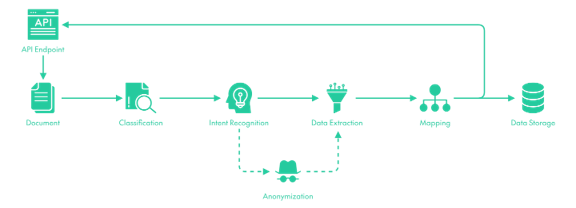
The process for processing invoices can vary greatly from company to company. This makes automation complex, as a multitude of factors must be taken into account. A key challenge lies in the heterogeneity of incoming documents:
– Different invoice layouts and formats
– Different item descriptions
– A mixture of invoices and other documents in the same input channel
– Invoices with additional requests (“Please refund,” “Please process as XY”)
Despite this complexity, certain core steps can be identified that occur in almost every invoice process. The synvert Invoice Automation Solution solves precisely these problems and delivers a modular and highly customizable solution. Either as an end-to-end solution for complete dark processing or to support existing processes.
Depending on the heterogeneity and the current level of automation, significant increases in automation can be achieved. Continuous technical and functional testing along the entire processing chain ensures the quality of the results.

Classification of the document (e.g., invoice vs. other document) and evaluation according to additional criteria.

Interpretation of additional information or comments submitted with the invoice or
separately.

Structured capture of relevant invoice information from documents.

Mapping of the extracted data to internal objects such as cost centers, teams, or catalogs.
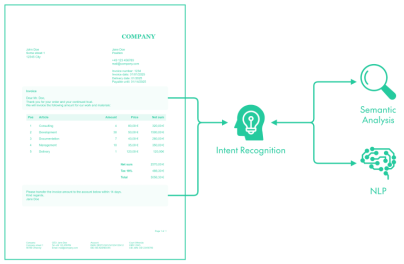
Business documents such as invoices, quotes, orders, and internal correspondence often contain additional notes, comments, or intentions that are crucial for downstream processes. In addition to classic invoice information such as “Please reimburse,” these can also include instructions such as “Post to project XY,” “Forward for approval,” or “Check urgently.” The synvert Invoice Automation Solution extends its functionality beyond pure invoice processing and enables the automated recognition and interpretation of intents in a wide variety of document types. With the help of NLP, semantic analysis, and state-of-the-art language models, context and meaning are reliably identified and converted into structured follow-up actions. Individual requirements: Different companies require different classification criteria. Our solution is highly flexible and can be tailored precisely to customer-specific categories – from invoices and credit notes to edge cases. Integration and modularity: The classification component integrates seamlessly into existing infrastructures, operates in batch and real-time modes, and supports operation in virtually any system environment. Quality: The synvert Invoice Automation Solution combines rule-based approaches with state-of-the-art language and classification models. This achieves maximum accuracy while optimizing cost efficiency.
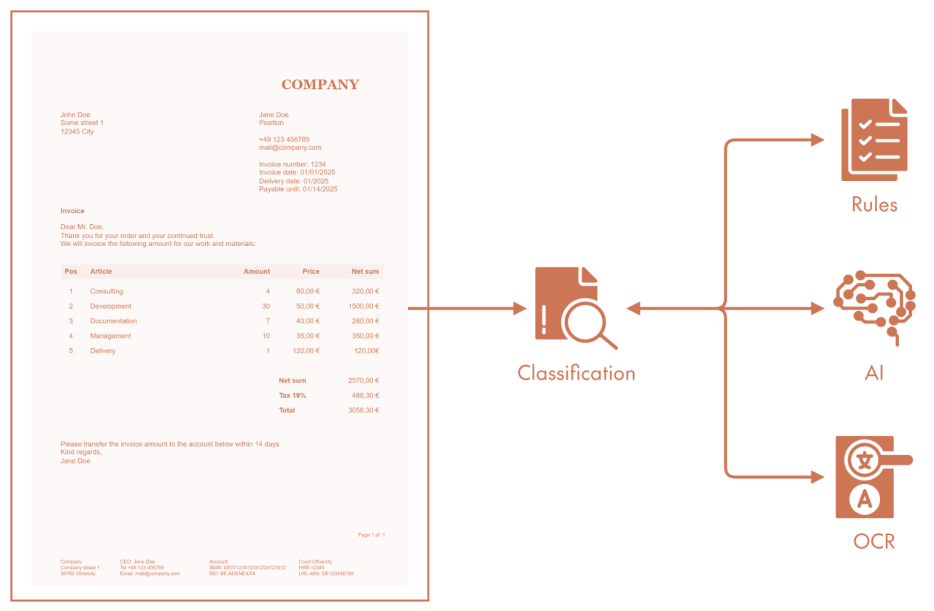
Classification is the first and crucial step in automating invoice processing. Documents must be clearly recognized and assigned to the correct category to ensure that downstream processes such as extraction, mapping, and verification can run smoothly. Our Invoice Automation Suite enables precise classification, even with unstructured and non-standardized input formats. The combination of rule-based procedures and AI-supported recognition methods ensures reliable classification – even with heterogeneous document types or deviating designations. Individual requirements: The range of possible intentions is wide and depends on the industry, company, and process environment. Our solution is highly configurable and recognizes both standardized wording and specific phrases typical for customers or industries. Integration and modularity: Intent recognition can be seamlessly integrated into existing processes and systems. Identified intentions can be forwarded directly to ERP, workflow, or ticketing systems, enabling automated and error-free further processing. Quality: State-of-the-art language models and semantic AI processes ensure a high degree of accuracy in the interpretation of even unstructured texts. This enables end-to-end automation, reduces manual work, and increases efficiency throughout the entire document management process.
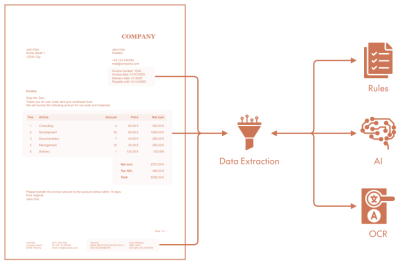
The extraction of line items from invoices is the central element in the automation of invoiceprocessing, especially when items are complex and invoices come in different formats. The synvert Invoice Automation Solution provides a solution for precisely this problem. Bycombining rule-based approaches, OCR frameworks with layout recognition, and (multimodal)language models, it is possible to extract and structure line items from a wide variety of invoicesand invoice types with a high degree of accuracy. This lays the foundation for subsequent automated processing. Individual requirements: Invoices and objectives of interest may vary for different customers. Our solution is highly customizable and extracts exactly the relevant information and passes it on in the desired format Integration and modularity: The synvert Invoice Automation Solution integrates seamlessly into your infrastructure and can process invoices in batches or in real time. Its modular architecture allows it to be exchanged and operated in almost any environment. AI-driven: Our solution relies on a combination of rule-based approaches and outstanding OCR frameworks and language models. This results in significantly higher quality results while taking cost efficiency into account.
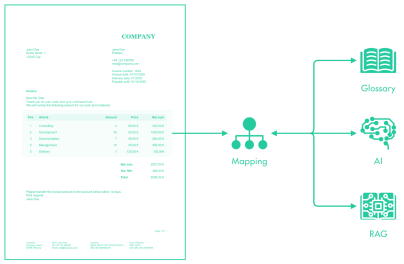
Automated invoice processing typically does not end with the extraction of individual line items. Often, the individual items must be assigned to different internal budgets, catalogs, catalog entries, or teams. Rule-based assignment fails here when the set of rules is highly complex or incomplete, or when new, unmaintained synonyms or abbreviations are used. This is exactly where the synvert Invoice Automation Solution comes in. Unknown synonyms or similar terms can be intercepted and assigned correctly, for example, by using a language model (possibly using a glossary and/or RAG). Of course, “clear cases” for optimizing cost efficiency are initially processed on a rule-based basis, but especially for the above-mentioned cases, a significant increase in the assignment rate and thus the degree of automation can be achieved here (depending on the incoming invoices): Assignment at item level: Assignment of each document item to internal catalogs for further automated processing. Adaptability: Processing procedures, customers, catalogs for mapping, and rules vary. That is why synvert Invoice Automation is flexibly adaptable and still delivers high-quality results. It offers every customer exactly what they need. Pre-processing: Processing all invoice line items—such as calculating a grand total or totals within different categories, which may be based on catalog entries, for example.
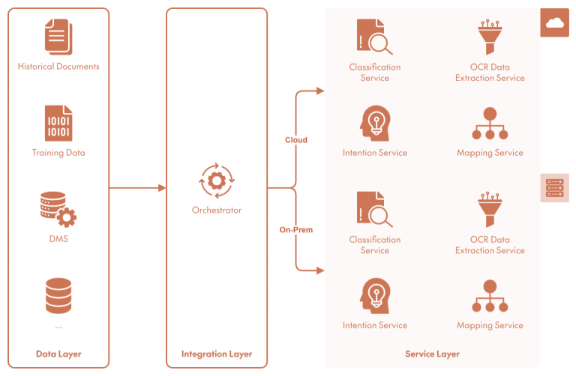
The synvert Invoice Automation Solution is designed as a modular end-to-end process. A central orchestrator controls the entire processing chain – from the capture of incoming documents to classification and intent recognition to data extraction and mapping. Thanks to its modularity and adaptability, the entire process can be customized to suit individual needs. All necessary services are connected in a modular fashion and can be replaced or expanded as needed. This allows the solution to be optimally adapted to specific requirements, existing IT landscapes, and regulatory frameworks. Ready to Deploy: Rapid deployment thanks to modular, cloud-agnostic architecture. Compliance: Our solution meets the highest standards of data protection, security, and traceability. Automated processes: End-to-end automation from document ingestion to system integration. Data Management: All processed data is securely stored, versioned, and managed. Modular design: The process is highly expandable and configurable in a flexible manner – additional models, services, or integration points can be added at any time.


You will shortly receive an email to activate your account.


