
The synvert Demand Forecast Accelerator replaces manual “gut feeling” with data-driven precision to automate complex demand planning across vast product ranges. By identifying hidden influencing factors, it significantly increases forecast accuracy, reducing both stockouts and excess inventory costs.
The synvert Demand Forecast Accelerator replaces manual “gut feeling” with data-driven precision to automate complex demand planning across vast product ranges. By identifying hidden influencing factors, it significantly increases forecast accuracy, reducing both stockouts and excess inventory costs.
The synvert Demand Forecast Accelerator replaces manual “gut feeling” with data-driven precision to automate complex demand planning across vast product ranges. By identifying hidden influencing factors, it significantly increases forecast accuracy, reducing both stockouts and excess inventory costs.

Many companies still rely on their employees’ gut feelings to estimate demand for their products and thus determine order volumes, warehouse inventory, and the stocking of individual stores. This expertise is very valuable, but it cannot identify all relevant factors and incorporate them into the planning process. The sheer number of influencing factors is overwhelming, the product variety is huge, and the data quality is often not optimal. The resulting non-optimized demand forecasts lead to immense avoidable opportunity costs.
Data-driven demand forecasts quickly increase forecast accuracy and deliver measurable success.

Product availability that meets demand not only increases sales, but also customer satisfaction and loyalty.

A 5% increase in forecast accuracy can reduce inventory levels by 15–20% without compromising product availability.

Avoid overstaffing and understaffing in warehouses and distribution centers by better predicting peaks and troughs in demand.

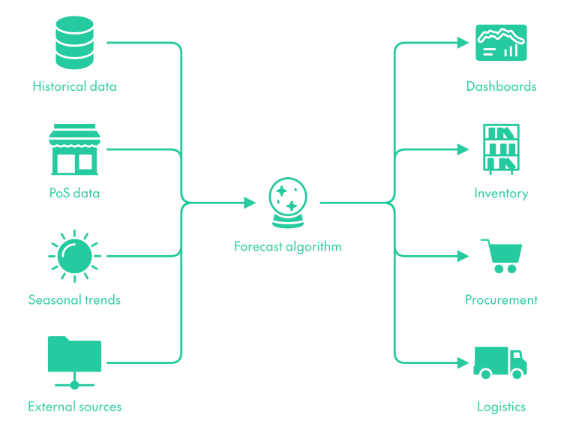
Modern forecasting models include all relevant factors in the forecast. From ERP data and inventory levels to location-specific influences and external APIs for weather and event data. You can be sure that your forecast takes everything into account.
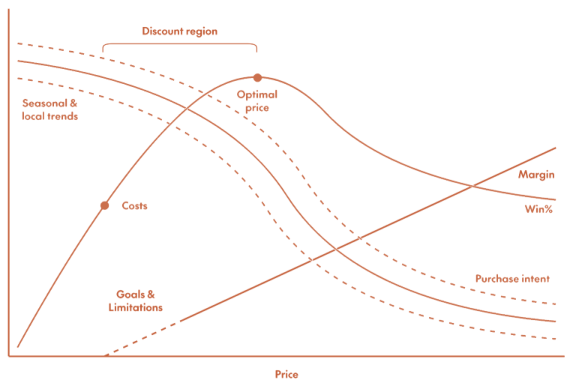
Pricing and discounting are closely linked to demand forecasts. Both have a huge impact on demand and must be included in forecasting models from the outset. Conversely, pricing can be supported and optimized by modeling demand for different price points. Based on this data-driven model, informed decisions can be made regarding pricing and product selection for discount campaigns. Price & quantity optimization: Determine the optimal price for your products and be sure that inventory levels meet demand. Product selection for discounts:Identification of products that can generate additional profit through targeted discounts. Discount Revenue: Increase total discount revenue and reduce products with negative discount revenue. Targeting: Targeted selection of products and their discount levels for different sales channels, individual locations, and target groups.
The choice between established standard solutions and developing your own solution is not trivial, let alone easy. It depends on your own IT landscape, technical and operational requirements, the business processes involved, and available capacities.
Purchasing a standard solution means a quick start and low initial costs, but also ongoing license fees, limited customizability, and hurdles when integrating it into your own systems. A custom-built solution involves higher initial costs and tied-up resources, but offers greater control and flexibility, as well as lower operating costs.
At synvert, a GlobalLogic company, we have supported demand forecasting projects in a variety of settings, from requirements analysis and implementation to handover and operations. In these projects, we have already identified millions in potential savings for our customers by not only developing models, but also creating holistic solutions, from data integration and feature engineering to embedding in existing processes.


You will shortly receive an email to activate your account.


